Making sense of time-travel: Dissociation between co-speech gesture and temporal reasoning
Jun 29, 2024· ,,,,,,,·
0 min read
,,,,,,,·
0 min read
Saloni Naik
Isabella Dohnke
Kaushik Ram
Julia Ton
Harini Muralidharan
Shervin Nosrati
Leo Niehorster-Cook
Tyler Marghetis
Abstract
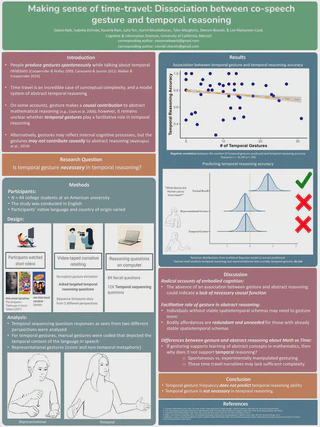
Time is incredibly abstract, yet humans reason about it in rich and flexible ways. And human conceptualizations of time continue to grow in complexity. Witness the advent of “time-travel” in fiction, a plot device that is now commonplace but which was introduced only 150 years ago. How do humans make sense of such a complex and paradoxical notion? One possibility is that people make sense of time-travel plots by building rich spatial models that use space metaphorically to represent chronologies (Lakoff & Johnson 1980). Spatial construals of time are apparent in the temporal gestures that people produce spontaneously while talking about temporal relations in simple plots or while describing simple temporal concepts (Cooperrider & Núñez 2009; Casasanto & Jasmin 2012; Walker & Cooperrider 2016). It remains unclear, however, whether these temporal gestures play a functional role in temporal reasoning — that is, whether actually producing these gestures facilitates temporal reasoning. On some accounts, actually producing hand gestures makes a causal contribution to reasoning (e.g., Cook et al. 2008). Alternatively, gestures may reflect internal cognitive processing but the gestures themselves may not contribute to reasoning (e.g., Walkington et al., 2019). In the current study, therefore, we investigated whether spontaneous co-speech temporal gestures facilitate reasoning and recall of temporally-complex narratives involving time-travel. Participants (N = 45) retold narratives that involved time-travel. Participants watched videos in which the main character traveled back and forth between the present and the past. They were then asked to retell the narratives while adopting different perspectives:once from the perspective of the main character who is traveling back and forth through time, and again from a “god’s eye” perspective of somebody who is all-seeing but not traveling through time. These interviews were video-recorded and coded for the number of non-temporal representational gestures and temporal gestures. Afterwards, participants completed a computer-based test of their temporal reasoning and recall of the time-travel narratives. Results revealed that temporal gestures were spontaneous, frequent, and patterned with non-temporal gestures — but were unrelated to temporal reasoning and recall. During narrative retellings, nearly every participant (84%) spontaneously produced temporal gestures that used space to represent time. The frequency of temporal gestures was highly correlated with the frequency of non-temporal representational gestures, suggesting that temporal and non-temporal gestures share a generating process. However, the presence and frequency of temporal gesture was unrelated to subsequent temporal reasoning and recall. A Bayesian linear model of reasoning accuracy confirmed that temporal gesture frequency was not predictive of temporal reasoning, with credible intervals that were tight around 0 (i.e., no relationship). These results confirm that temporal gestures are produced spontaneously when communicating temporal information, even for the complex and paradoxical temporal relations that characterize time-travel. However, these findings are inconsistent with extreme embodied views of the functional role of gesture, in which temporal reasoning requires or leans heavily on the actual physical production of temporal gestures. Instead, temporal gestures may be the outward manifestation of rich internal reasoning — reasoning that is deeply metaphorical but does not require outward expression to succeed.
Type
